

148 - What does grieving look like? A model.

Welcome back!
Helen’s mom, Sophia, died five years ago. After the initial struggle with COVID logistics, Helen and her siblings followed Sophia’s instructions carefully. They had to. Sophia had warned them she’d haunt them if they messed up.
At the time, they all laughed, confident that she’d have better things to do. But it’s hard to relax after life with a loving perfectionist.
The service was outside because of the restrictions. Someone brought a couple fire pits. There were quilts on the chairs, some of them made by Sophia. “Use them,” she had always said. “I’m quilting with a machine so you won’t worry about mom’s hand stitching.” Sophia’s niece, sang the one song Sophia had requested: “I come to the garden alone, while the dew is still on the roses.”
Helen laughed. They were in the garden, or could see it across the church parking lot. But it was February. There was no dew. There were no roses.
Kevin, her husband, glanced at her, and handed her another tissue from the box on the seat next to him.
After the service, after the meal, after the drive home, after the deep sleep, she poured her morning coffee and thought, “That’s done.”
But, of course, it wasn’t.
+++
Part of the struggle in understanding all that is going on following the death of our person is that any one model cannot capture all that is going on. A model that handles all the variables would simply be life. So, we choose models, or metaphors, to help us with the current moment.
Grieving as developing (or learning)
I’m learning about a newish model attempting to help us understand grieving. What’s compelling about this one, for me, is that it talks about time in a way that suggests that there are different struggles and different ways of being helpful during different periods following the death of a person.
Neimeyer and Cacciatore suggest three periods of grieving, and a core crisis for each period captured by a basic question.1
In early grieving, the weeks after the death, we’re asking “How and why did this happen?” We’re bouncing back and forth between feeling the isolation of loss and needing connection: “I’m the only one who has ever felt this way, and no one can really help. But don’t leave me.”
Helen’s friends kept calling, wondering how she was doing. Sophia had been a second mom to many of them. And was the first death, at least of an adult, that many of them were experiencing.
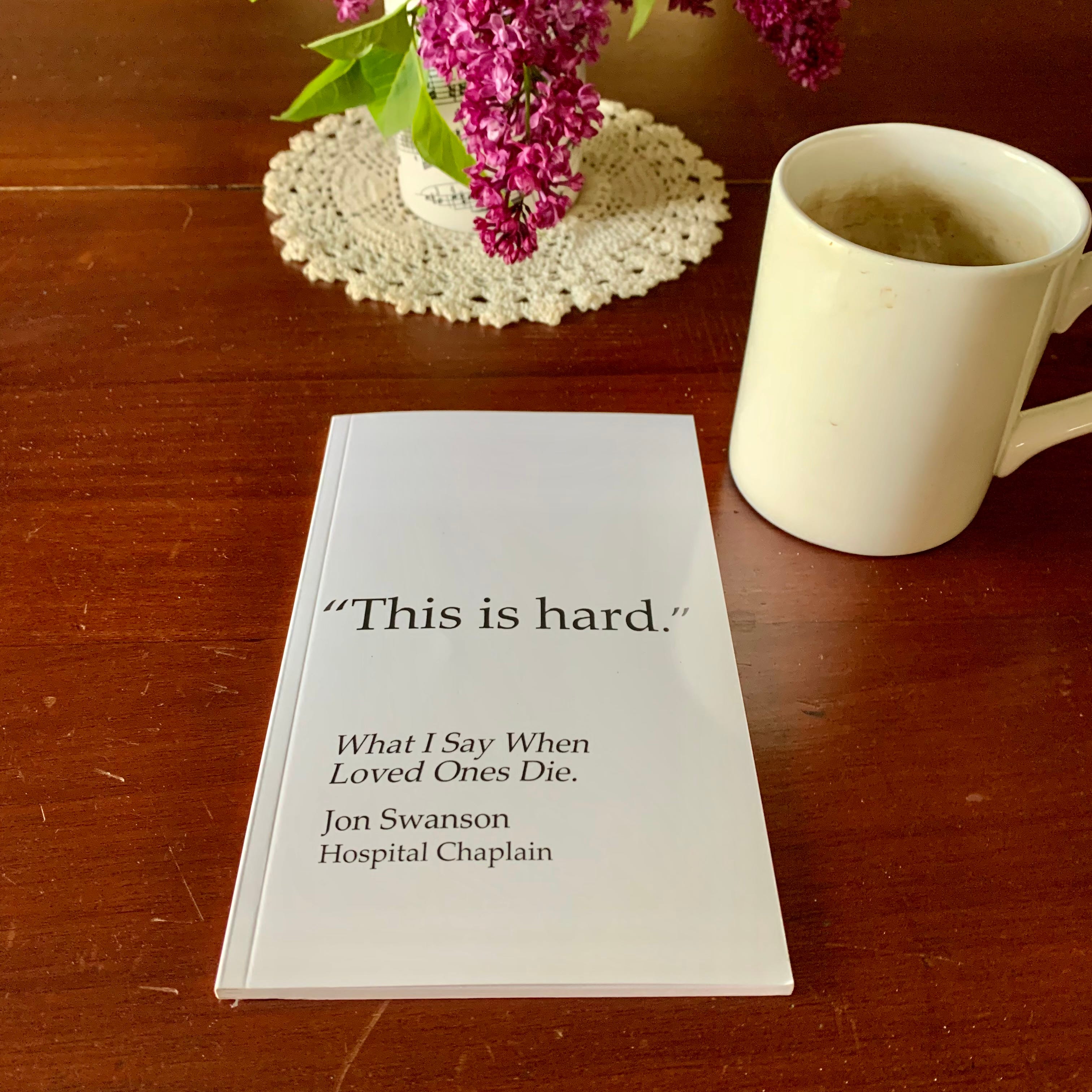
The intensity of feeling in C.S. Lewis’s A Grief Observed illustrates the internal (and often external) dialogue of this period. The most helpful support in the early period is listening and compassion. Rather than trying to answer questions, we are most helpful by acknowledging the importance of the questions. Responding with “This is hard” is one way of being with.
In middle grieving, the months after the death, we’re asking “Where do I locate my loved one?” We’re struggling with security and insecurity.
By “locate”, researchers aren’t talking about the factual location of the molecules of the body. When we think of people in our lives, we think about the way they are part of our habits, our conversations, our decisions. So, in this period, we are trying to figure out whether and how we are still connected.
Eventually, Helen found one of the quilts her mom had machine-stitched. She put in on her lap while drinking her morning coffee. It felt comfortable. On the other hand, she gave the mugs her mom had given her to Goodwill. They had never fit her hand quite right. And now she didn’t have to worry about using them.
Most of her friends had quit asking how she was doing. But a couple were still happy to hear Sophia stories that popped up in the middle of conversations that had nothing to do with her.
The most helpful support in the middle period is being an audience for stories and giving permission to stay connected (in some way) to their person. In my own early research, I found that story-telling includes telling the story of the death, telling stories about their person, and hearing stories about their person that they didn’t know.
During this time, people may want to participate in memorials or create legacy projects. People start memorial scholarships, join GriefShare groups, visit the cemetery, continue to visit the same coffee shop (or avoid it). Joan Didion’s husband died suddenly from a cardiac arrest. She wrote her memoir of that death and the following year, The Year of Magical Living, in three months, ending the day after the anniversary of her husband’s death.
Helen, by the way, didn’t really like Didion’s book. Or most of the grief memoirs she read. She decided that she didn’t have to like them.
In late grieving, the years after the death, we’re asking, “Who am I now?” We’re wrestling with meaning and meaninglessness.
The most helpful support is to acknowledge that these questions are still part of grieving (rather than saying, “I’m glad you are all better”), to give permission and support for change and for remembering.
After considering volunteering at the local quilt club, Helen shook her head. Quilts were her mom’s thing, not hers. But the people she works with know that she’s their advocate when it comes to writing compassionate HR policies.
A couple months ago, Helen came across a memoir that was helpful.
Nicholas Wolterstorff wrote Lament for a Son during the year after his son Eric’s death in a climbing accident. Fourteen years later he wrote a new preface for the book. He gives us an illustration of the periods of this developmental model of grief.
“The wound is no longer raw. But it has not disappeared. That is as it should be. If he was worth loving, he is worth grieving over. Grief is the existential testimony to the worth of the one loved. That worth abides.
So, I own my grief. I do not try to put it behind me, to get over it, to forget it. I do not try to dis-own it. If someone asks, ‘Who are you, tell me about yourself,’ I say – not immediately but shortly— ‘I am one who lost a son.’ That loss determines my identity; not all of my identity, but much of it. It belongs in my story. I struggle indeed to go beyond merely owning my grief toward owning it redemptively. But I will not and cannot disown it. I shall remember Eric. Lament is part of life.” P 5-6.
+++
+++
Thanks for reading.
I’ve written about memoirs before: On grief memoirs.
And when I drink coffee, I’m often sitting next to the desk that sat in my dad’s office. Ben loves sorting through the desk drawer that still has some of the debris that accumulates in desk drawers.
See you next week.
Jon
Neimeyer, R. A., & Cacciatore, J. (2016). Toward a developmental theory of grief. In R. A. Neimeyer (Ed.), Techniques of grief therapy: Assessment and intervention (pp. 3–13). Routledge/Taylor & Francis Group.